


Why Avoiding Uncertainty Can Strengthen OCD Over Time and How Therapy Addresses It
Why Avoiding Uncertainty Can Strengthen OCD Over Time and How Therapy Addresses It
Understanding the Relationship Between OCD and Uncertainty
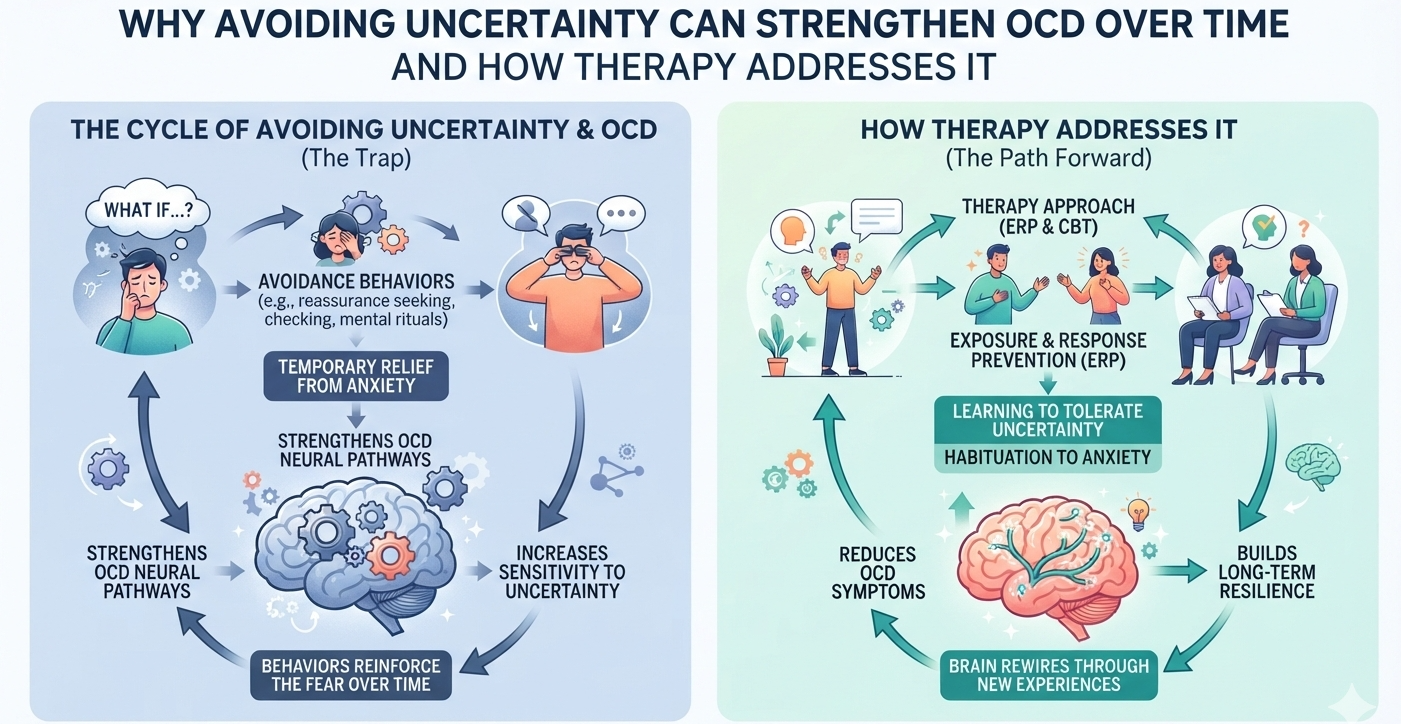
Obsessive-compulsive disorder, commonly known as OCD, can involve an intense need to feel certain, safe, or completely confident about thoughts, decisions, situations, and potential outcomes. For someone experiencing OCD, uncertainty may feel much more threatening than it does to other people, even when there is no immediate danger. A person may repeatedly question whether they made a mistake, whether something bad could happen, or whether they can trust their own memory or judgment. These doubts can create significant anxiety and lead to behaviors intended to reduce that discomfort. Although those behaviors may provide temporary relief, they can unintentionally teach the brain that uncertainty is something that must always be eliminated. Over time, this cycle can make obsessive thoughts feel more urgent and compulsive behaviors feel increasingly necessary.
Why Avoiding Uncertainty Can Become a Problem
Avoiding uncertainty can take many different forms, and it is not always obvious that avoidance is taking place. Someone may repeatedly check a door, appliance, message, document, or bodily sensation because they want complete reassurance that everything is fine. Another person may repeatedly ask family members, friends, or professionals for reassurance because they want confirmation that their fears are unfounded. Some people may avoid making decisions unless they feel completely confident, while others may spend extensive amounts of time researching, reviewing, analyzing, or mentally replaying situations. These responses can feel logical in the moment because they appear to offer a way to achieve certainty. However, the relief they provide can reinforce the belief that uncertainty is dangerous or intolerable. As this pattern repeats, the person may become increasingly dependent on checking, reassurance, avoidance, or mental rituals to manage everyday doubt.
The Short Term Relief That Keeps the Cycle Going
One of the reasons OCD can become persistent is that compulsive responses often produce immediate emotional relief. When anxiety rises because of an intrusive thought, performing a compulsion can temporarily make that anxiety decrease. The brain can then learn an important but unhelpful association between the compulsion and relief.
For example, if someone repeatedly checks a locked door and feels calmer afterward, the brain may interpret the checking as necessary for safety. The next time uncertainty appears, the urge to check may become stronger because the previous behavior seemed to work. Eventually, the person may feel less capable of tolerating uncertainty without performing the compulsion, which can allow the OCD cycle to become more entrenched.
How Reassurance Can Reinforce OCD
Reassurance seeking is another common response to uncertainty, and it can be particularly difficult to recognize because asking for reassurance is a normal human behavior in many situations. The problem arises when reassurance becomes repetitive, urgent, or necessary before the person can move forward with ordinary activities.
Someone may repeatedly ask whether they said the wrong thing, whether a relationship is okay, whether a symptom means something serious, or whether a decision was correct. Even when reassurance provides comfort, the relief may not last because OCD can generate another question soon afterward.
The person may then seek additional reassurance, creating a cycle in which certainty must constantly be restored. Therapy can help individuals recognize this pattern and gradually develop a greater ability to respond to doubt without repeatedly seeking external confirmation.
Understanding Intolerance of Uncertainty
Intolerance of uncertainty refers to the difficulty a person may experience when facing situations where complete knowledge or control is impossible. Uncertainty is an unavoidable part of everyday life, but OCD can make ordinary ambiguity feel especially uncomfortable or threatening. A person may believe that they need to know exactly what happened, exactly what will happen, or exactly what their thoughts mean before they can feel comfortable. This expectation can create an impossible standard because absolute certainty is rarely available.
Trying harder to achieve complete certainty may therefore result in more checking, analyzing, researching, questioning, and avoidance. A major goal of effective OCD treatment is not to guarantee certainty, but to help a person become more comfortable with the fact that certainty is sometimes unavailable.
How Evidence Based Therapy Addresses the Cycle
At Focus DFW, we recognize that OCD treatment often involves addressing the behaviors and mental strategies that keep the obsessive-compulsive cycle active. One of the most established approaches for OCD is Exposure and Response Prevention, commonly referred to as ERP. ERP involves gradually and intentionally approaching situations, thoughts, sensations, or uncertainties that trigger OCD while reducing the compulsive responses that would normally follow. The process is structured and individualized so that challenges can be approached in a manageable way. Rather than trying to prove that feared outcomes will never happen, therapy focuses on developing the ability to tolerate uncertainty without relying on compulsions. With consistent practice, a person can learn that anxiety and uncertainty can be experienced without automatically responding to them through rituals or avoidance.
Learning to Respond Differently to Intrusive Thoughts
A central part of OCD treatment is changing how a person responds to intrusive thoughts rather than trying to eliminate every unwanted thought. Intrusive thoughts can be disturbing, strange, unwanted, or completely inconsistent with a person's values, and their presence does not automatically mean that they are meaningful or predictive. Attempts to analyze why a thought appeared or what it says about a person can sometimes increase its importance.
Therapy can help individuals notice intrusive thoughts without entering into prolonged mental debates about whether the thoughts are true, significant, or dangerous. This can involve learning to allow thoughts to exist without immediately checking, neutralizing, suppressing, or disproving them. Over time, the person can develop greater confidence in allowing uncertainty to remain unresolved.
Facing Uncertainty Without Performing Compulsions
Therapy does not require a person to enjoy uncertainty or pretend that uncomfortable situations are easy. Instead, treatment can help people practice experiencing uncertainty while choosing not to perform the compulsive behaviors that OCD demands. This might involve making an ordinary decision without repeatedly reviewing it, leaving a situation without checking it again, or resisting the urge to ask another person for reassurance.
These experiences can initially produce anxiety because the familiar method of obtaining temporary relief is being interrupted. With repeated practice, however, the person can discover that anxiety can change naturally without requiring a compulsion. This process can weaken the learned connection between uncertainty and compulsive behavior.
The Importance of Gradual and Individualized Treatment
Effective OCD therapy should be adapted to the individual's symptoms, triggers, circumstances, and treatment goals rather than following an identical formula for everyone. A therapist can help identify the situations in which uncertainty creates the strongest urges to check, avoid, analyze, or seek reassurance. Treatment exercises can then be developed in a gradual manner that provides meaningful therapeutic challenge without unnecessarily overwhelming the individual. Progress is generally built through repeated practice rather than a single breakthrough experience. As individuals gain experience tolerating uncertainty, they may become increasingly capable of handling situations that previously triggered strong compulsive urges. The objective is to build practical skills that can continue to be used outside the therapy setting.
Why Complete Certainty Is Not the Goal
For someone living with OCD, it can be tempting to believe that recovery means finally becoming completely certain that feared outcomes will not occur. Unfortunately, that goal can keep the OCD cycle alive because it places the person back into the search for absolute reassurance. Therapy instead emphasizes a different form of confidence, which is confidence in one's ability to handle uncertainty when it arises. A person may not know exactly what will happen, whether a decision was perfect, or whether an intrusive thought will return. They can still learn that they do not need to solve every doubt before continuing with their life. This shift can be powerful because it changes the focus from controlling every possible outcome to developing flexibility in responding to uncertainty. In this way, treatment addresses not only individual compulsions but also the broader relationship a person has with doubt.
Building Long Term Resilience
Reducing compulsions can create opportunities for individuals to spend less time responding to OCD and more time participating in relationships, work, education, hobbies, and everyday activities. The goal is not simply to reduce anxiety during therapy sessions, but to develop skills that can be applied when intrusive thoughts and uncertainty appear in real life. There may still be difficult moments, and occasional intrusive thoughts are a normal part of human experience. What changes is the person's response to those experiences and their willingness to continue without automatically engaging in compulsive strategies. As these skills strengthen, uncertainty can become less controlling and less central to daily decision making. Long term progress comes from repeatedly practicing a different response, even when the old response initially feels more comfortable.
Moving Toward a Healthier Relationship With Uncertainty
Uncertainty cannot be completely removed from life, and trying to eliminate it can sometimes give OCD more influence rather than less. When checking, avoidance, reassurance, and mental rituals become the primary methods for managing doubt, they can unintentionally reinforce the very fears a person is trying to escape. Therapy offers an opportunity to interrupt that pattern by helping individuals face uncertainty in a structured and supportive way. Approaches such as ERP can help people reduce compulsive responses while developing greater tolerance for uncomfortable thoughts and feelings. The process takes practice, patience, and individualized support, but meaningful change is possible. By learning that uncertainty does not always require an immediate answer or action, individuals can begin to reclaim time, flexibility, and control over their lives.